
Adult Autism Assessment

Adult Autism Assessment
Gaining clarity through neuroaffirmative assessment.
Full Assessment Cost
£1999

At CADS, we understand that autism affects every individual differently. Our face-to-face assessments are designed to identify autistic adults so that you get the support you need.
What is autism?
There are various definitions of autism from different organisations. At CADS we prefer the National Autistic Society defintion:
“Autism influences how people experience and interact with the world. It is a lifelong neurodivergence and disability. Autistic people are different from each other, but for a diagnosis they must share differences from non-autistic people in how they think, feel and communicate. Being autistic means you may feel things and react to them differently to non-autistic people. You may find socialising confusing or tiring, and you may become overwhelmed in loud or busy places. You may have intense interests, prefer order and routine, and use repeated movements or actions to calm yourself or express joy.” (National Autistic Society)
Signs and Symptoms
Autistic individuals often process and experience the world in a way that is different from their non-autistic peers. The presence of these characteristics can vary widely depending on a person’s age, environment, and communication style. In adulthood, many autistic people learn to ‘mask’ or hide their traits to fit in, which can make it more difficult to spot the signs and may lead to a later-in-life diagnosis. It’s important to remember that every autistic person is unique, with their own strengths, communication preferences, and sensory experiences. Understanding these differences can provide valuable insights into their world.
A person may have a different way of showing their feelings or understanding what others are feeling.
They may have a different communication style, which can lead to a mutual challenge in understanding between people (this is referred to as the double empathy problem).
They may have a literal and precise communication style, which helps them understand information clearly.
A person may thrive with predictability and structure, as it helps create a sense of safety and calm.
Where we work
Cumbria Assessment and Diagnostic Service (CADS) conducts autism assessments within clients’ homes across the area shown on our map below. Travel within this area is included in the assessment fee. Appointments outside of this region may incur an additional travel charge, so please let us know if your address falls outside our mapped area
Payment Structure
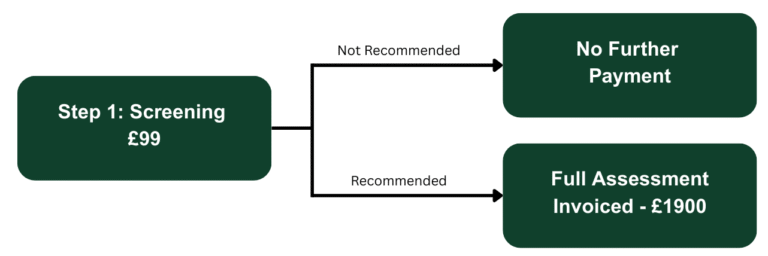
Autism assessment is a significant financial commitment, and we want you to feel supported and informed throughout the process. The flow chart below outlines how our model works. Our pathway begins with a screening appointment (see What to expect for details), with a £99 fee payable at the point of booking. If we recommend a full assessment and you choose to proceed, the remaining £1900 will be invoiced to you. If we do not recommend a full assessment, or if you decide not to continue, there is no further payment, and you will receive a letter summarising the screening appointment.
What to expect from your assessment
Our assessments are informed by National Institute for Health and Care Excellence (NICE) Guidance and contemporary research that tells you if you are autistic or not. They are typically made up of the following steps:
- Screening appointment (up to 60 minutes) via an online video call
- Autism Clinical Interview for Adults (ACIA), executive functioning, and sensory assessment (face-to-face in your home)
- Formulation (i.e., understanding all the information we have gathered together)
- Feedback appointment and the written report
- If diagnosed, you will receive a post-diagnostic support appointment
Step 1: Screening Appointment
Your journey with CADS begins with a screening appointment, held online via Microsoft Teams. This meeting lasts around 60 minutes.
During this session, we will explore your reasons for seeking an autism assessment, learn more about your life and experiences, and think together about whether a full assessment would be the most helpful next step. The screening appointment is not a diagnostic assessment in itself. Instead, it acts as a snapshot to help us decide whether moving forward with a full assessment is recommended.
- If we recommend a full assessment, this does not mean you have received a diagnosis — it simply means we believe an in-depth exploration would be valuable.
- If we do not recommend a full assessment, you will receive a written summary of the meeting along with our reasons, so you have clarity about our decision. This step helps ensure that your time, energy, and resources are used in the most meaningful and appropriate way


Step 2: Autism Clinical Interview for Adults (ACIA)
If we recommend a full assessment after Step 1, we move to a more in-depth process. This involves gathering information from someone who knows you well (e.g., a family member or professional). This could include any reports or documentation you are happy to share, such as educational psychology reports or occupational health assessments. All involvement from others is voluntary, and we always seek your consent.
We then begin the Autism Clinical Interview for Adults (ACIA), developed at Newcastle University. The ACIA is a semi-structured diagnostic interview designed specifically for adults, assessing core autism traits and co-occurring conditions. This is usually completed over 2–3 sessions, depending on your needs.
Alongside the interview, we complete an assessment of your executive functioning (skills such as planning, attention, and memory) and sensory processing (how you notice and respond to sights, sounds, touch, and other sensory experiences). These help us build a thorough understanding of your strengths and differences.

Step 3: Formulation
Once all the assessment sessions are complete, we move to the formulation stage. This is where we bring together all the information we have gathered – from interviews, questionnaires, reports, assessments, and other multi-disciplinary information – to create a clear understanding of your strengths, differences, and how these affect your daily life.
During this step, we write a comprehensive report summarising our findings. The report includes our professional interpretation of the assessment results and highlights patterns, areas of difference, and ways to support you effectively.
This step is important because it turns the information collected into a meaningful understanding that can guide recommendations, support, and next steps tailored to you.

Step 4: Feedback and Report
During this appointment, we provide feedback on the outcome of your assessment. We explain the reasons for any diagnostic conclusions and give you the opportunity to ask questions and discuss your experience. Any recommendations for support or next steps will be agreed during this session and included in your written assessment report. The report will be sent to you shortly after the feedback appointment.
We generally advise that your GP receives a copy of the report to help coordinate care, but we will only share it with your consent. If you receive a diagnosis, you will also be offered a session of post-diagnostic support to help you understand what the diagnosis means and explore strategies or resources that may be helpful.

Final Step: Post-diagnostic Support
If you receive a diagnosis, we offer a session of post-diagnostic support to help you make sense of it in a way that is meaningful to you. This session focuses on understanding your unique strengths and differences, exploring strategies and resources that may be helpful, and discussing any questions or next steps.
The goal is to provide practical guidance and reassurance, empowering you to use the information from your assessment in a way that supports your day-to-day life and personal goals.

Step 2: Autism Clinical Interview for Adults (ACIA)

If we recommend a full assessment after Step 1, we move to a more in-depth process. This involves gathering information from someone who knows you well (e.g., a family member or professional). This could include any reports or documentation you are happy to share, such as educational psychology reports or occupational health assessments. All involvement from others is voluntary, and we always seek your consent.
We then begin the Autism Clinical Interview for Adults (ACIA), developed at Newcastle University. The ACIA is a semi-structured diagnostic interview designed specifically for adults, assessing core autism traits and co-occurring conditions. This is usually completed over 2–3 sessions, depending on your needs.
Alongside the interview, we complete an assessment of your executive functioning (skills such as planning, attention, and memory) and sensory processing (how you notice and respond to sights, sounds, touch, and other sensory experiences). These help us build a thorough understanding of your strengths and differences.
Step 3: Formulation & Diagnosis
Once all the assessment sessions are complete, we move to the formulation stage. This is where we bring together all the information we have gathered – from interviews, questionnaires, reports, assessments, and other multi-disciplinary information – to create a clear understanding of your strengths, differences, and how these affect your daily life.
During this step, we write a comprehensive report summarising our findings. The report includes our professional interpretation of the assessment results and highlights patterns, areas of difference, and ways to support you effectively.
This step is important because it turns the information collected into a diagnostic decision and provides a meaningful understanding that can guide recommendations, support, and next steps tailored to you.

Step 4: Feedback and Report

During this appointment, we provide feedback on the outcome of your assessment. We explain the reasons for any diagnostic conclusions and give you the opportunity to ask questions and discuss your experience.
Any recommendations for support or next steps will be agreed during this session and included in your written assessment report. The report will be sent to you shortly after the feedback appointment.We generally advise that your GP receives a copy of the report to help coordinate care, but we will only share it with your consent.
If you receive a diagnosis, you will also be offered a session of post-diagnostic support to help you understand what the diagnosis means and explore strategies or resources that may be helpful.
Final Step: Post-diagnostic Support
If you receive a diagnosis, we offer a session of post-diagnostic support to help you make sense of it in a way that is meaningful to you. This session focuses on understanding your unique strengths and differences, exploring strategies and resources that may be helpful, and discussing any questions or next steps.
The goal is to provide practical guidance and reassurance, empowering you to use the information from your assessment in a way that supports your day-to-day life and personal goals.